
How much protein do I need a day?
You do not need a lecture. You need a number you can actually use, and a plain way to hit it.
General education, not a personal target.
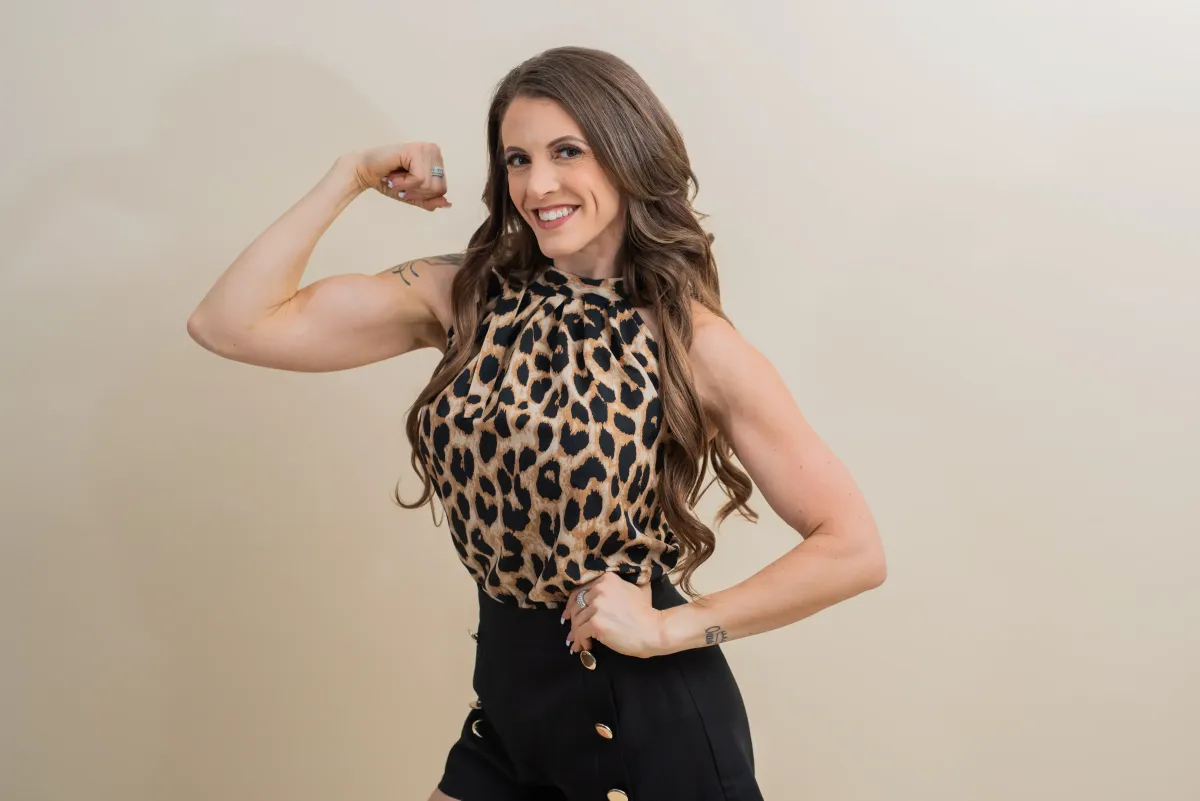
Most women land between 0.8 and 2.0 grams of protein per kilogram of body weight a day. Where you land depends on how you train and whether you are losing fat or building muscle. The calculator below turns that into a real number, a range, and a per-meal target you can actually eat.
What is my number?
Five questions. It gives you a daily range, a midpoint to aim for, and what that looks like on one plate.
A reasonable daily range: 100 to 130 grams.
Show me the math
Everything below is fixed arithmetic. No hidden assumptions, no algorithm.
Step 1. The weight the calculator uses
Protein need tracks lean mass more closely than total body weight, and lean mass does not rise in a straight line with body fat. So above 200 lb (90.7 kg) the calculator counts only half of the extra weight, and it never calculates on more than 250 lb (113.4 kg). At or below 200 lb your actual weight is used.
Example: 260 lb becomes 200 + (60 ÷ 2) = 230 lb. 340 lb becomes 250 lb, the cap.
Step 2. The base range, set by how you train
| Your week | Grams per kg per day | Where it comes from |
|---|---|---|
| Mostly sitting | 0.8 to 1.2 | 0.8 g/kg is the traditional adult guideline quoted by PROT-AGE. 1.2 g/kg is the bottom of the NIH ODS active range. |
| Active most days | 1.2 to 1.6 | Lower half of the 1.2 to 2.0 g/kg band the NIH ODS fact sheet gives for active people. |
| Strength training 3+ days a week | 1.4 to 2.0 | The ISSN 2017 protein position stand, point 2, verbatim. |
Step 3. The goal adjustment
- Maintain: no change.
- Lose fat: add 0.2 g/kg to both ends. Rationale: in a calorie deficit the job is holding muscle, and the ISSN position stand on diets and body composition reports that higher protein helps trained people retain muscle under hypocaloric conditions.
- Build muscle: the range becomes 1.4 to 2.0 g/kg, the ISSN band for building and maintaining muscle mass, if it is not already at least that high.
Step 4. The age nudge
If you select 40 and over, both ends move up by 0.1 g/kg and the low end is never allowed below 1.0 g/kg.
What the source actually supports. PROT-AGE recommends 1.0 to 1.2 g/kg a day for healthy older adults and 1.2 g/kg for those who exercise, and that paper is written for people over 65, not over 40. There is no published guideline that changes at 40. The 0.1 nudge is a deliberately small, conservative lean in the direction the evidence points, not a claim that the research says 40.
Step 5. The ceiling and the rounding
The top of the range is never taken above 2.0 g/kg, the top of the ISSN band. Both ends and the midpoint are rounded to the nearest 5 grams. The midpoint is the middle of the unrounded range, then rounded. Per meal is the midpoint divided by your meals a day, rounded to the nearest 5 grams.
Step 6. The food equivalents
Computed from USDA FoodData Central, SR Legacy:
- Chicken, broilers or fryers, breast, meat only, cooked, roasted (FDC 171477): 31.0 g protein per 100 g
- Yogurt, Greek, plain, lowfat (FDC 170903): 9.95 g protein per 100 g, counted in 170 g cups
- Egg, whole, raw, fresh (FDC 171287): 12.6 g protein per 100 g, 1 large egg = 50 g
- Tofu, raw, firm, prepared with calcium sulfate (FDC 172475): 17.3 g protein per 100 g
Sources
- Jäger R, et al. International Society of Sports Nutrition Position Stand: protein and exercise. J Int Soc Sports Nutr, 2017.
- Aragon AA, et al. ISSN position stand: diets and body composition. J Int Soc Sports Nutr, 2017.
- NIH Office of Dietary Supplements. Dietary Supplements for Exercise and Athletic Performance.
- Bauer J, et al. PROT-AGE Study Group position paper. J Am Med Dir Assoc, 2013.
- USDA FoodData Central, SR Legacy entries listed above.
Please read this part. This is general education, not a personal protein target, and not medical advice.
Talk to a clinician before changing your protein intake if you have kidney disease, are pregnant or breastfeeding, or have been told to limit protein. Their number replaces this one.
Built by Julie Salter, NASM certified personal trainer and nutrition coach. Sources checked September 15, 2026.
Prefer a quick lookup? See ranges by weight
Find your weight on the left, read across to your goal.
| Your weight | Maintain | Lose fat | Build muscle |
|---|---|---|---|
| 120 lb | 65 to 85 g | 75 to 100 g | 75 to 110 g |
| 140 lb | 75 to 100 g | 90 to 115 g | 90 to 125 g |
| 160 lb | 85 to 115 g | 100 to 130 g | 100 to 145 g |
| 180 lb | 100 to 130 g | 115 to 145 g | 115 to 165 g |
| 200 lb | 110 to 145 g | 125 to 165 g | 125 to 180 g |
| 220 lb | 115 to 150 g | 135 to 170 g | 135 to 190 g |
| 240 lb | 120 to 160 g | 140 to 180 g | 140 to 200 g |
| 260 lb | 125 to 165 g | 145 to 190 g | 145 to 210 g |
Rows assume active most days, under 40. Lifting three or more days a week puts you at the top. Over 40, add five to ten grams. Above 200 lb the ranges use a capped reference weight.
Does my protein need change after 40?
"Somewhere after thirty, your body changes the rules. I teach women the new ones."
Here is what the research actually supports. The PROT-AGE group recommends 1.0 to 1.2 grams per kilogram a day for healthy older adults, and 1.2 or more for those who exercise. That paper is written for people over 65, not for people over 40.
So no separate guideline kicks in on your fortieth birthday. What does exist is a direction of travel: muscle gets harder to hold, and protein plus resistance training is how you hold it.
That is why the calculator nudges the 40 and over band up by 0.1 grams per kilogram. A nudge, not a new rule.

Is more protein always better?
No. The range has a top for a reason.
The ISSN 2017 position stand on protein and exercise puts 1.4 to 2.0 grams per kilogram a day as sufficient for building and maintaining muscle in people who exercise. Above that the return gets small for most women, and the calories have to come from somewhere.
Protein does not build muscle on its own either.
"Protein is the material. Lifting is the signal."
Coaching does
- Turn a number into meals you will actually eat
- Build the strength training that makes the protein matter
- Hold the plan together in a real week
Coaching does not
- Diagnose, prescribe, or interpret your labs
- Tell you whether a higher protein intake is safe for your kidneys, your pregnancy, or your medication
- Replace medical care
How do I hit the number without tracking every bite?
Anchor it to meals, not to an app.
Take your daily number, divide it by the number of meals you actually eat, and build each plate around that. Most women land somewhere between 30 and 45 grams a meal. That is a palm-sized portion of meat or fish, a cup of Greek yogurt with something on top, or a tofu and egg scramble.
"Food you can actually eat, on a Tuesday, in your real life."
Start with breakfast. It is the meal where protein is usually lowest and the easiest one to fix. Then check dinner. If those two hit, the day usually does.
- Put the protein on the plate first, then build the rest of the meal around it.
- Check the number once a week, not once a meal.
What changes when you stop guessing?
A target turns protein from a vague virtue into something you can check.
"I teach you how to eat for fat loss without cutting the foods you love and build habits that actually stick."
"For me it was my schedule, so she built a plan that fit into my busy life, and included ideas of what macro goals I should have and how they play a role in weight loss and overall health!"Michael, via Trustpilot
What else do I need to know?
How much protein do I need a day to lose weight?
In a calorie deficit, the goal is to keep the muscle you already have while fat comes off. The ISSN position stand on diets and body composition reports that higher protein intakes help lean, trained people retain muscle under hypocaloric conditions. In practice that means sitting toward the top of your range, not the bottom, while you are losing.
Should I calculate protein per pound or per kilogram?
Either works, because they are the same math. The research is written in grams per kilogram, so that is what this calculator uses under the hood. If you prefer pounds, roughly 0.6 to 0.9 grams per pound of body weight covers most of the same ground.
Why does the calculator cap the number at higher body weights?
Protein need tracks lean mass more closely than total body weight, and lean mass does not rise in a straight line with body fat. So above 200 pounds the calculator counts only half of the extra weight, and it never calculates on more than 250 pounds. That keeps the number usable instead of theoretical.
What counts as a high-protein meal?
Using USDA FoodData Central values, 30 grams of protein is roughly 3.4 ounces of cooked chicken breast, about six ounces of firm tofu, five large eggs, or two cups of plain Greek yogurt. Most people underestimate how much food that actually is.
Is this calculator safe for everyone?
No calculator is. This one gives a general education range, not a personal target. If you have kidney disease, are pregnant or breastfeeding, or have been told by a clinician to limit protein, use their number instead of this one.
Where should I go next?
So what do I do with this number?
A number is a starting point, not a plan. Build one around it, and pick only the pieces you need.
You pick the pieces. The price moves with you.
Sources
- Jäger R, et al. International Society of Sports Nutrition Position Stand: protein and exercise. Journal of the International Society of Sports Nutrition, 2017. Supports 1.4 to 2.0 g per kg per day for building and maintaining muscle mass in exercising individuals, and 20 to 40 g per meal.
- Aragon AA, et al. International Society of Sports Nutrition position stand: diets and body composition. Journal of the International Society of Sports Nutrition, 2017. Supports higher protein for muscle retention under hypocaloric conditions.
- National Institutes of Health, Office of Dietary Supplements. Dietary Supplements for Exercise and Athletic Performance. States 1.2 to 2.0 g per kg (0.55 to 0.9 g per lb) for athletes.
- Bauer J, et al. Evidence-Based Recommendations for Optimal Dietary Protein Intake in Older People: A Position Paper From the PROT-AGE Study Group. Journal of the American Medical Directors Association, 2013. Recommends 1.0 to 1.2 g per kg per day for healthy adults over 65, and notes the traditional adult guideline of 0.8 g per kg.
- USDA FoodData Central, SR Legacy: chicken breast cooked (FDC 171477), Greek yogurt plain lowfat (FDC 170903), whole egg (FDC 171287), firm tofu (FDC 172475).
This page is general education, not medical advice, and not a personal target. Coaching supports nutrition habits, strength training, planning, and accountability. It does not diagnose, prescribe, interpret your labs, or replace medical care. Talk to a clinician before changing your protein intake if you have kidney disease, are pregnant or breastfeeding, or have been told to limit protein.
Julie Salter Fitness
Do less. Eat more. Lose the weight. Helping busy women lose inches, eat the foods they love, and build results that actually last.
Explore
About CEO
Who we help
Programs
Apply for coaching
Check HSA/FSA Eligibility