
What is the 4B Approach, and why does it work when diets stop?
Somewhere after thirty, your body changes the rules. I teach women the new ones. Not with another meal plan, and not with a workout you will quit in nine days. Four layers deep, because the reason it stopped working was never that you weren't trying hard enough.
HSA and FSA eligible through Truemed.
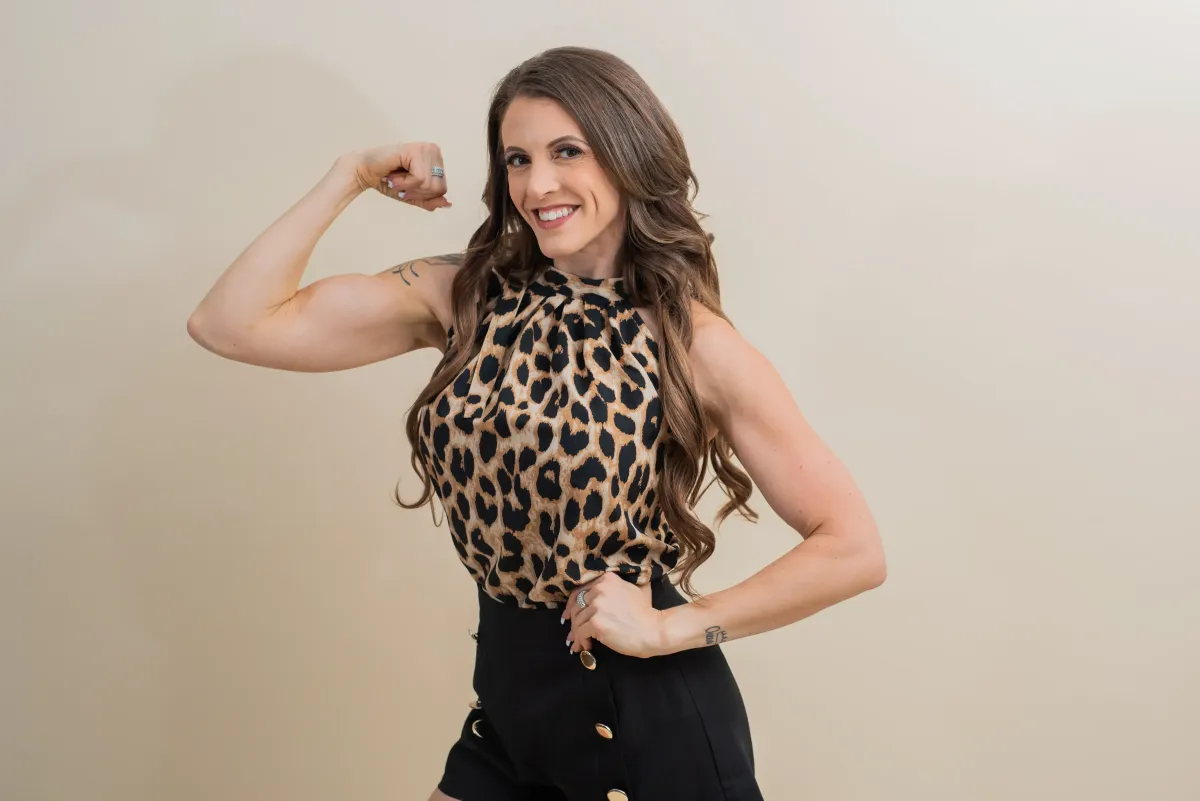
The 4B Approach is the coaching method behind every Julie Salter Fitness program. It works on four layers at once: Biology (what your body is doing), Behavior (the skills), Belief (who you are on the bad days), and Bandwidth (making it hold in your real life). Diets fix one layer. That is why they stop.
Where did the 4B Approach come from?
It came from my own kitchen, not a textbook. I lost 70 pounds and I've kept it off for over 4 years. Before that, I was the woman this page is written for.
For years I tried every diet, started over, and watched the weight come back. I could lose it, I just couldn't keep it off. A new plan, a burst of motivation, and then right back where I started.
Everything changed when I stopped chasing quick fixes and learned to build something sustainable. I learned to eat in a way that supported fat loss without giving up the foods I loved, move in ways I could actually enjoy, and build habits that fit my real life instead of fighting it.
Then I noticed I wasn't alone. So many women cycle through the same pattern I did, trying, failing, starting over, not from a lack of discipline, but because the approach they were given was never built to last.
That is why I founded Julie Salter Fitness. When I looked at what had actually changed for me, it was never one thing. It was four things, and they had to happen together.
"A diet asks you to change one thing. Keeping the weight off asked me to change four."
The four layers got names: Biology, Behavior, Belief, Bandwidth. Since then, 470+ women have worked through them with me. You can read the longer version of my story on the about page.

What does each of the four layers address?
Anyone can hand you macros. This goes four layers deeper. Here is the map; each card links to the full section below.
Biology
What the body is actually doing. Hormones, thyroid, metabolism, sleep, digestion, real lab work instead of guesswork. You cannot out-discipline a system working against you.
Read the Biology layer → 02Behavior
The skills, so you stop guessing. Training that builds you instead of draining you. Food you can actually eat, on a Tuesday, in your real life.
Read the Behavior layer → 03Belief
Who you are on the bad days. Not mindset. Mindset is the story you tell when things go well. Belief is what you do when they do not.
Read the Belief layer → 04Bandwidth
Making it hold in the life you actually have. The busy season, the sick kid, the travel, the grief. Most plans are built for a life with nothing else in it. Yours gets built for the one you are living.
Read the Bandwidth layer →"Most programs pick one layer and call the other three your fault."
Biology: what is my body actually doing when a diet stops working?
Biology is what the body is actually doing while you are trying to lose weight. Hormones, thyroid, metabolism, sleep, digestion. It is the layer most programs skip, and the layer that explains why week three of a diet feels harder than week one.
When you eat a lot less than your body is used to, it does not sit still. It adapts. Researchers call this adaptive thermogenesis: a drop in the energy your body burns at rest that is bigger than the drop you would expect from simply weighing less. A 2016 review in Current Obesity Reports by Müller and colleagues describes it as a "biological defence of body weight". During a deficit the body moves toward energy sparing, and after weight loss that sparing can linger, which is part of why keeping weight off is harder than losing it.
That is not a character flaw. You cannot out-discipline a system working against you.
Sleep sits in the same layer. The National Heart, Lung, and Blood Institute puts it simply: when you do not get enough sleep, the hormone that makes you hungry (ghrelin) goes up and the hormone that makes you feel full (leptin) goes down, so you feel hungrier than when you are rested. If every diet you have tried started during a stretch of five-hour nights, the diet was never the only variable.
Coaching stops the guessing. We look at what you are actually eating, how you are sleeping, and how your body responds week to week. Where something looks off, the answer is real lab work instead of guesswork, interpreted by your clinician. I do not read your labs or diagnose anything.
For some women, it isn't only about habits: it's hormones, metabolism, and energy working against them, even when they're doing everything right. For those women, I offer access to advanced metabolic and peptide support, including GLP-1 options, through a licensed medical team. It's never the starting point, and it's not for everyone.
"Biology is the layer that turns 'what is wrong with me' back into 'what is my body responding to.'"
"I was surprised with how quickly I lost weight while eating more food in a day than I normally did. Turns out I was consistently under eating and all the foods I ate just got stored as fat. She upped my calories slowly to get me used to eating the calorie amount I should be at and I somehow lost 20 lbs in the first few months while doing it."Barbara, via Trustpilot
Individual experiences vary. Results are not typical or guaranteed.
Behavior: what skills replace the guessing?
Behavior is the skills, so you stop guessing. Not rules. Skills. A rule is "no bread after 6 p.m." A skill is building a plate that keeps you full until dinner, in a restaurant, with your kids, on a Tuesday.
Most programs focus on restriction. I don't. The tighter the rules, the bigger the swing back when real life shows up. The Behavior layer replaces the swing with a handful of skills you keep for good.
The first skill is eating enough protein, most days, without a spreadsheet. The International Society of Sports Nutrition's position stand puts the daily range for most people who train at 1.4 to 2.0 grams per kilogram of body weight, spread across meals of roughly 20 to 40 grams. In coaching, that becomes a number that fits you and foods you actually like, not a list of foods you are allowed. For a starting range now, use the protein calculator.
The second skill is training that builds you instead of draining you. Federal activity guidelines from the CDC and HHS call for at least 150 minutes of moderate activity a week plus muscle-strengthening work for all major muscle groups on at least two days. That two-day line is the one most women's plans ignore, and it is the one that protects carrying groceries and getting off the floor at seventy. I call that Future Freedom, and it is why strength work is in every JSF program.
The third skill is the plate, the grocery list, and the restaurant menu. Food you can actually eat, on a Tuesday, in your real life. Wine nights, holidays, dinners out, all of it fits. No more starting over every Monday.
"A rule tells you what you cannot have. A skill tells you what to do next."
"With previous diets I felt like I was going without things I wanted, but with Julie's help I can literally have whatever I want. I feel so free and have developed a better relationship with food thanks to her."Amanda, via Trustpilot
Belief: who am I on the bad days?
Belief is who you are on the bad days. Not mindset. Mindset is the story you tell when things go well. Belief is what you do when they do not.
Good weeks were never the problem. The problem was the Thursday after a bad Wednesday, when one meal turned into "I've already blown it" and one day turned into a month.
That story is the engine of the restrict-and-rebound cycle. It is learned, which means it can be unlearned. In coaching we practice a different response to a bad day: notice it, eat the next meal like a normal person, move on. No punishment workout. No skipped breakfast to "make up for it."
You can't hate your way into a body you love, and this is the layer where that finally ends. I did not lose 70 pounds by getting stricter with myself. I lost it, and kept it off, when I stopped treating every slip as evidence.
It's not about perfection, it's about always showing up. The client who checks in on her worst week is the one who keeps her results.
"Mindset gets you through a good week. Belief gets you through a bad one."
What this layer is not. Belief work in coaching is practical: what you do after a hard day, how you talk to yourself in a check-in, what "back on track" actually means. It is not therapy, and it does not replace mental health care. If you are struggling with more than food, please tell your clinician or a licensed therapist, and tell me too so the plan can flex.
Bandwidth: how does a plan hold in the life I actually have?
Bandwidth is making it hold in the life you actually have. The busy season, the sick kid, the travel, the grief, the weeks where you have nothing left to give.
Most plans are built for a life with nothing else in it. Yours gets built for the one you are living. That is the design rule for every plan I write.
In practice it looks like this. A plan has a full version and a floor version, and the floor is decided in advance, not in a panic. The full week might be four strength sessions and a planned grocery run. The floor might be two twenty-minute sessions, protein at every meal, and takeout you chose on purpose. Both count. Neither is "starting over."
It also looks like check-ins that change the plan instead of grading you against it. When a client's mother is in the hospital, the answer is not "stay consistent." It is a two-week floor plan and a message that says we build back up when she is ready.
A plan that only works in a quiet month will hand the weight back in a loud one.
"Consistency is not doing the whole plan every week. It is never doing nothing."
"She designs programs specifically for YOU, your goals, fitting it into your life so you can actually find something you can stick with long term or for your life which is probably one of the hardest things to do."Raquel, via Trustpilot
How is this different from a macro app?
Honest answer: a macro app is a good tool, and for a self-starter who already knows what to do, it may be enough. I use tracking tools with clients. The difference is not the numbers. It is the other three layers.
An app does not know you slept four hours, that your knee hurts, or that your father just moved in. It cannot tell you whether the number it handed you is too low for your body's response. When you miss three days, it sends a notification, not a plan.
"An app tracks what you ate. Coaching changes what happens next week."
| A macro app | 4B coaching | |
|---|---|---|
| What you get | A calorie and macro target, a food log | A plan across all four layers, adjusted weekly |
| Who sets the target | A formula | A coach, from your intake, training, sleep, and week-to-week response |
| When life changes | The target stays the same | The plan changes: a full week and a floor week |
| Strength training | Sometimes a generic library | Programmed for you, progressed over time |
| Sleep, stress, hormones | Not part of the plan | Part of the plan, with lab work through your clinician when it is warranted |
| Bad weeks | A reminder notification | A check-in and a next step |
| Cost | Low cost or free | A monthly coaching investment. See Build Your Own Program. |
| Best for | A self-starter who knows what to do and needs a log | A woman who has done the logging and is still stuck |
If you want the self-guided version of my system, that is what the JSF App is for. If you want the four layers with a coach watching them, that is coaching. The comparison page lays out every option side by side.
How does it apply if I'm on GLP-1, in menopause, or neither?
The four layers do not change. The weight each one carries does. Every JSF program starts from the same framework and gets tuned to the entry point.
Behavior moves to the front
Biology is being supported by your prescriber. Behavior becomes the priority: enough protein and strength work to protect muscle while appetite is low, and a plan for life after the medication.
Biology moves to the front
Sleep, recovery, strength training, and eating enough instead of cutting further. Bandwidth matters more than ever, because this season rarely comes with spare time.
Belief and Behavior carry the weight
Unlearning the restrict-and-rebound cycle and building skills that survive a normal week. This is where most women start.
"The framework stays the same. The starting layer is yours."
What is a metabolic health coach, and what can't one do?
A metabolic health coach helps you change the daily things that shape how your body uses energy: what and how much you eat, how you train, how you sleep and recover, and how you handle stress and setbacks. In plain terms, it is nutrition and fitness coaching that takes the body's response seriously instead of assuming every plateau is a discipline problem.
Here is what one cannot do. Coaching does not diagnose, prescribe, choose a dose, change medication, direct tapering, interpret your personal labs, or replace medical care. "Metabolic health coach" is not a medical license, and anyone who lets you believe otherwise is not doing you a favor.
"A good coach knows exactly where coaching ends, and says so before you ask."
Coaching does
- Build your nutrition plan and the skills to run it
- Program and progress your strength training
- Plan for sleep, stress, and busy seasons
- Check in weekly and adjust
- Hold you accountable without shame
- Help you prepare questions for your clinician
Coaching does not
- Diagnose a condition
- Prescribe or adjust medication or a dose
- Direct tapering off medication
- Order or interpret your personal labs
- Treat a medical or mental health condition
- Replace your physician, dietitian, or therapist
| Metabolic health coach | Registered dietitian | Clinician | |
|---|---|---|---|
| Helps with | Habits, nutrition skills, training, planning, accountability | Medical nutrition therapy for diagnosed conditions, clinical diets | Diagnosis, medication, lab orders, medical treatment (physician, nurse practitioner, physician assistant) |
| Licensed | No license required. Certifications vary, so ask. | Yes, credentialed and licensed in most states | Yes |
| At JSF | Julie Salter and the JSF coaching team | Not provided by JSF | Peptide and metabolic support is offered through a licensed medical team. Never required, never where anyone starts. |
If a coach and a clinician both belong in your plan, they can work alongside each other. I build around what your clinician decides. I never decide it for them.
What credentials and experience is this built on?
Two kinds. The first is the training. I am a NASM certified personal trainer and nutrition coach. The credentials shown on the about page are:
- NASM Certified Personal Trainer
- NASM Certified Nutrition Coach
- NASM Group Fitness Instructor
- NASM Weight Loss Specialist
- GLP-1 Metabolic Health Coach
The second kind is the one no certificate covers. I lost 70 pounds and I've kept it off for over 4 years, and I built this method by living the cycle it is designed to end. Since founding Julie Salter Fitness, 470+ clients have worked with me, and together they have lost 1,257+ pounds.
"I teach the four layers because I needed all four myself."
I read every application myself
I personally review every single application to ensure my coaching style and methodology are the perfect fit. Take your time. There's zero pressure or rushed sales tactics.
Client reviews are on Trustpilot, in their own words, and on the results page.
What else do women ask about the 4B Approach?
Is the 4B Approach a diet?
No. A diet is a set of food rules with an end date. The 4B Approach is a coaching method that works on four layers at once, Biology, Behavior, Belief, and Bandwidth, so the results hold after the structure is gone. Wine nights, holidays, and dinners out are built in, not banned.
Do I have to count macros?
Not forever, and not the way an app makes you. Most clients track for a while so we both learn what you are actually eating, then move toward a protein target and a plate you can build without logging. The goal is skills you keep, not a spreadsheet you maintain.
Do I need lab work to start?
No. Most women start with food, training, sleep, and a weekly check-in. If your response to a well-built plan suggests something else is going on, the answer is real lab work instead of guesswork, interpreted by your clinician. I do not order or interpret labs.
Is GLP-1 or peptide support required?
No. Peptide and metabolic support, including GLP-1 options, is offered through a licensed medical team. It is never required, and it is not where anyone starts. Most clients never use it.
Can I follow the 4B Approach on my own?
Yes, if you are a self-starter. The JSF App carries the workouts, the JSF University education library, and a food journal, built for self-starters. Coaching adds a coach who reads your check-ins and changes the plan when your life changes.
How long until I see results?
I do not promise a timeline, because your biology, your history, and your season of life all affect it. Coaching runs on a six month minimum or a discounted twelve month term because skills and belief take repetition, not a thirty-day sprint. Individual results vary and are not guaranteed.
Where should I go next?
So what should I actually do?
If you have done the diets and you are done starting over, apply. I read every application myself, and there is no pressure on the other end of it.
You pick the pieces. The price moves with you. HSA and FSA eligible through Truemed.
Sources
View Sources
- Müller MJ, Enderle J, Bosy-Westphal A. Changes in Energy Expenditure with Weight Gain and Weight Loss in Humans. Current Obesity Reports, 2016. doi.org/10.1007/s13679-016-0237-4
- National Heart, Lung, and Blood Institute (NIH). Sleep Deprivation and Deficiency: How Sleep Affects Your Health. Updated June 15, 2022. nhlbi.nih.gov
- Jäger R, Kerksick CM, Campbell BI, et al. International Society of Sports Nutrition Position Stand: protein and exercise. Journal of the International Society of Sports Nutrition, 2017. link.springer.com
- Centers for Disease Control and Prevention. Adult Activity: An Overview (Physical Activity Guidelines for Americans, 2nd edition). Reviewed December 20, 2023. cdc.gov
This page is general education about a coaching method, not medical advice. Coaching does not diagnose, prescribe, or replace care from your clinician. Individual results vary and are not guaranteed.
Julie Salter Fitness
Do less. Eat more. Lose the weight. Helping busy women lose inches, eat the foods they love, and build results that actually last.