Semaglutide and Muscle Loss: How to Protect Yours
Semaglutide and Muscle Loss: How to Protect Yours
Written by Julie Salter, September 1, 2026
If you are on a GLP-1 medication and you have read that it is taking your muscle, here is the short version. The muscle loss is real; it has been measured, and it is not a reason to stop.
It is a reason to add the part the medication was never going to do for you. The prescription handles your appetite. Nothing about it handles your muscle. That gap is yours to close, and it is closable.
What the research actually found
In 2024, four researchers in body composition published a commentary in The Lancet Diabetes and Endocrinology called "Muscle matters." It is the piece most of the headlines you have seen are quoting from, usually badly.
What it reported is this. Across studies running 36 to 72 weeks, the loss of fat-free mass with these medications came to somewhere between 25 and 39 percent of the total weight lost. Fat-free mass is not all muscle, but muscle is a large part of it.
That is a real number and it deserves your attention. On an annual basis, the authors noted, the decline is several times larger than the muscle loss you would expect from aging alone, which runs at roughly 0.8 percent a year between forty and seventy.
The exploratory body composition analysis from the STEP 1 trial gives you the picture in one person's body. Over 68 weeks, participants on semaglutide lost about 15 percent of their body weight. Total fat mass fell by 19.3 percent. Visceral fat, the kind around your organs, fell by 27.4 percent. Lean body mass fell by 9.7 percent.
So yes. It came off both.
The part the headlines leave out
Now the nuance, because it changes how worried you should be.
The same Lancet commentary said the muscle loss is largely attributable to the size of the weight loss rather than to an independent effect of the drug on muscle. Put plainly, it is not that semaglutide hunts down your muscle. It is that losing a large amount of weight quickly costs lean tissue, and these medications are very good at producing a large amount of weight loss.
For comparison, the authors noted that ordinary calorie restriction studies, with smaller weight losses, produce fat-free mass losses in the range of 10 to 30 percent of total weight lost. The same phenomenon. Different scale.
There is a second piece of context worth holding. In STEP 1, lean mass fell in absolute terms, but as a proportion of total body mass it went up by three percentage points. There was less of it, and it made up more of what was left.
Both of those things are true at once. Most articles you will find pick whichever one supports the story they want to tell. I would rather you had both.
Why this matters more for women in midlife
In 2025, four organizations published a joint advisory on nutrition and GLP-1 therapy: the American College of Lifestyle Medicine, the American Society for Nutrition, the Obesity Medicine Association, and The Obesity Society.
They named who is most at risk of losing muscle on these medications. Older age. Perimenopausal or menopausal status. Sedentary behavior. Lack of resistance training. Low protein intake caused by reduced appetite.
Read that list again. If you are a woman in your forties or fifties who has never lifted weights and whose appetite has just dropped through the floor, you are on four of those five.
That is not a reason to be frightened. It is a reason to be specific. You know exactly which levers apply to you, which is more than most people get.
If you have not yet, it is worth reading what happens when you eat too little for too long, because the underlying mechanism is the same one and the medication makes it easier to fall into.
The problem the medication creates for you
Here is the practical crux, and it is the thing I spend the most time on with clients in this situation.
The medication works by reducing your appetite. That is the point of it. That is what you are paying for.
But protein is the hardest macronutrient to eat when you do not want to eat. It is filling. It takes chewing. It sits heavily when your stomach is emptying slower than it used to. So the very thing that makes the drug effective is the thing that makes protecting your muscle harder.
Most women in this situation are not failing at discipline. They are eating a third of what they used to and the protein is the first thing to fall out, because a piece of toast goes down easily and a chicken breast does not.
That is a solvable problem. It is a planning problem, not a willpower problem. It is Behavior, the second B in my 4B Approach: the skills, so you stop guessing.
The two things that protect muscle
The research converges on the same two, and on one uncomfortable point about the order they go in.
Protein, with a target. The joint advisory and the broader literature point to intakes above the standard recommended allowance during active weight loss. The Obesity Society describes a target in the range of 1.2 to 1.6 grams per kilogram of body weight per day during active weight loss. A 2025 review of GLP-1 optimization describes intakes above 1.2 grams per kilogram per day, distributed evenly across meals rather than concentrated at dinner.
Even distribution matters more when you are eating less overall. If most of your protein arrives at 7pm, most of your day was spent without it.
Resistance training, actually done. The CDC recommends muscle-strengthening activity on at least two days a week, covering all the major muscle groups: legs, hips, back, chest, abdomen, shoulders and arms. Their guidance points to 8 to 12 repetitions per exercise, worked to the point where another repetition would be difficult, building toward two or three sets.
And here is the line from that joint advisory that I want you to take away above everything else in this article. The authors wrote that clinicians should understand, and emphasize to people taking GLP-1s, that increased protein intake alone is likely inadequate to preserve muscle mass in the absence of structured resistance training.
Protein without training is half a plan. It gives your body the material and no reason to use it.
What belongs with your prescriber, not with me
I want this line drawn clearly, because plenty of people in my industry blur it.
Your dose, your titration schedule, whether to keep going, whether to stop, what to do about side effects, what your labs mean, and whether this medication is right for you at all: those belong with the licensed medical professional who prescribed it. Not with a coach. Not with me.
What I do is the other half. Building a protein target you can actually hit on a low appetite. Structuring meals so the protein lands across the day. Putting a strength program in front of you that fits the week you actually have. Keeping you consistent while your body changes underneath you.
The joint advisory recommends that people starting these medications get a baseline assessment of muscle strength, function and body composition. If nobody has offered you that, it is a reasonable thing to ask for.
Questions worth taking to your next appointment
Holding on to muscle is possible
I want to end on what the evidence suggests is achievable, with the caveat stated honestly.
A 2025 case series in SAGE Open Medicine followed three patients losing weight on semaglutide or tirzepatide while resistance training three to five days a week and eating protein deliberately. Their total weight losses were large, between 13 and 33 percent. One of them lost 8.7 percent of that weight as lean soft tissue. The other two increased their lean soft tissue.
Three people. That is a case series, not a trial, and I am not going to dress it up as more than it is. It does not prove causation and the authors do not claim it does.
But it is a real signal, and it points the same direction as everything else here. Muscle loss on these medications is not a fixed tax you pay. How much you lose depends heavily on what you do alongside the prescription.
You already made the hard decision. This is the easier half.
Common questions
Should I stop taking my medication because of muscle loss? That is not a coaching decision and I will not weigh in on it. Take the question to your prescriber. What I can tell you is that stopping is not the only available response to this concern, and the alternative response, adding protein and strength work, is available to you today.
Will I lose muscle even if I do everything right? Some lean mass loss accompanies almost any significant weight loss. The realistic goal is to lose much less of it, not none of it. Both the research and clinical practice support that goal.
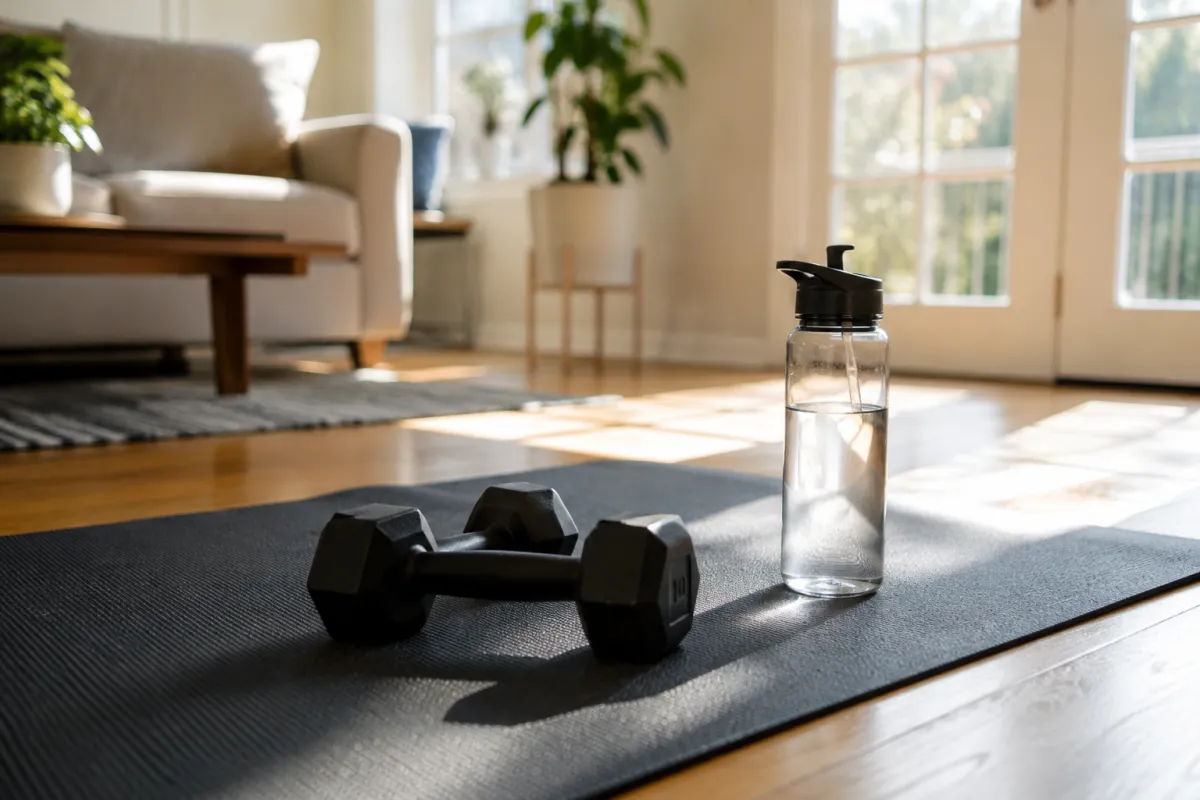
Do I need to lift heavy weights? The CDC guidance is two or more days a week working all major muscle groups, at an effort where another repetition would be hard. That is achievable with dumbbells at home. It is a starting point, not an endpoint, and the load goes up over time as you get stronger.
Sources
Prado CM, Phillips SM, Gonzalez MC, Heymsfield SB. Muscle matters: the effects of medically induced weight loss on skeletal muscle. The Lancet Diabetes and Endocrinology, 2024.
Impact of Semaglutide on Body Composition in Adults With Overweight or Obesity: Exploratory Analysis of the STEP 1 Study.
Mozaffarian D and colleagues. Nutritional priorities to support GLP-1 therapy for obesity: a joint Advisory from the American College of Lifestyle Medicine, the American Society for Nutrition, the Obesity Medicine Association, and The Obesity Society. American Journal of Clinical Nutrition, 2025.
The Obesity Society, guidance on preserving lean mass during weight loss.
Optimizing GLP-1 therapies for obesity and diabetes management, 2025 review.
Tinsley GM, Nadolsky S. Preservation of lean soft tissue during weight loss induced by GLP-1 and GLP-1 and GIP receptor agonists: a case series. SAGE Open Medicine, 2025.
Centers for Disease Control and Prevention, physical activity guidance for adults.
This article is general education. It is not medical advice, it is not a diagnosis, and it is not a recommendation to start, continue, change or stop any medication.